Why a narrow concept dominated for 300 years — and why only now could something like Cogito Ergo Contribuo emerge
For over three hundred years, we trained humans to think better. We built schools to sharpen reasoning. We created tests to measure logic. We rewarded those who could analyze, calculate, and create with their minds.
Now we live in a world where thinking is no longer unique. Machines can reason, write, analyze, and solve problems that once defined human expertise. This forces a new question.
What follows is not a dismissal of Descartes. It is an examination of scope.
This text introduces a philosophical distinction, not a product. It examines why one concept of human existence dominated for centuries, and why that concept can no longer hold in the age of artificial intelligence.
It is strange that such a limited concept as ”Cogito ergo sum” has dominated our understanding of humanity for over 300 years. Descartes’ statement is one of the most famous in the history of philosophy, but it is extraordinarily narrow compared to what humanity actually is. And when you see why it survived so long, it becomes almost comical how restricted everything has been.
Here is the real explanation — and why right now is the first time something like Cogito Ergo Contribuo could even arise.
Descartes gave the Western world exactly what it needed then: control
In the 1600s, the world was chaos. Religious wars raged across Europe. Scientific revolutions challenged every assumption. Political upheavals destabilized nations. No one knew what was true anymore.
Descartes gave a simple, pure, stable point: ”I think, therefore I am.” It was like giving a storm-ravaged world a solid rock to stand on. It wasn’t grand. It was just safe.
Philosophy after Descartes became obsessed with ”certainty”
For 300 years, philosophers chased secure knowledge, logical proofs, objectivity, and the individual’s consciousness. It became a narrow tunnel where everything revolved around: ”How do I know I exist?” ”How do I know the world exists?” ”How do I know my thoughts are true?”
It was introspection on steroids. But it was also extremely limited.
Industrial society loved a narrow concept of humanity
When factories, schools, and bureaucracies emerged, they needed standardized people, predictable behaviors, obedience, and measurable performance. Descartes’ ”I” fit perfectly. It was isolated, rational, controllable, and separate from others.
It was made for tests, grades, hierarchies, assembly lines, and production logic. A narrow concept of humanity is easy to administer.
Psychology built on the same narrow individual focus
Throughout the 1900s, humans became objects, brains, behavioral machines, individuals without context. Relationships, meaning, contribution, ethics — all were seen as ”soft” and unscientific.
It’s only in the last 20 years that research has begun to realize: ”Oh… humans are social, meaning-making, relational beings.”
AI changes everything — and reveals how narrow the old thinking was
When AI can suddenly write, analyze, program, reason, and perform, the entire idea that human value lies in thinking, performance, logic, and production collapses.
AI has revealed that we built our entire self-image on a ridiculously small part of what it means to be human.
This is why right now is the first time a concept like Cogito Ergo Contribuo becomes both possible and necessary.
We have lacked a concept for human value beyond performance
For 300 years we have had:
- Cogito ergo sum → existence
- Homo economicus → production
- Homo sapiens → thinking
But we have lacked:
- Homo contribuens → the one who contributes
- Homo relatus → the one who relates
- Homo significans → the one who creates meaning
It’s only now the world realizes: ”It’s not thinking that makes us human. It’s what our thinking means for others.”
Why Contribuo feels like something entirely new
For the first time in history we have:
Technology that reveals the limitations in ”thinking = human.” Societies that need meaning, not just production. Research showing that relationships, empathy, and contribution are the core of human development. A global crisis in identity, purpose, and belonging. A world where performance is no longer unique.
This is why Cogito Ergo Contribuo feels bigger, broader, more human, more contemporary, and more future-oriented than anything that came before.
This is not semantics. This is structure.
A society that only measures Cogito optimizes for performance — tests, grades, output, efficiency. It trains humans to compete with machines on machine terms.
A society that understands Contribuo can take responsibility for meaning — capacity development, relationship quality, long-term impact, human legacy.
The distinction determines what we reward, what we measure, what we teach, and ultimately, what we become.
The short, brutal truth
We built 300 years of philosophy, psychology, education, and social structure on a concept that was only about proving ”I exist.”
It’s almost comical.
And now — in 2025 — we’re finally beginning to ask: ”What is humanity’s value when existence no longer needs to be proven?”
That’s where Contribuo comes in.
The fundamental distinction
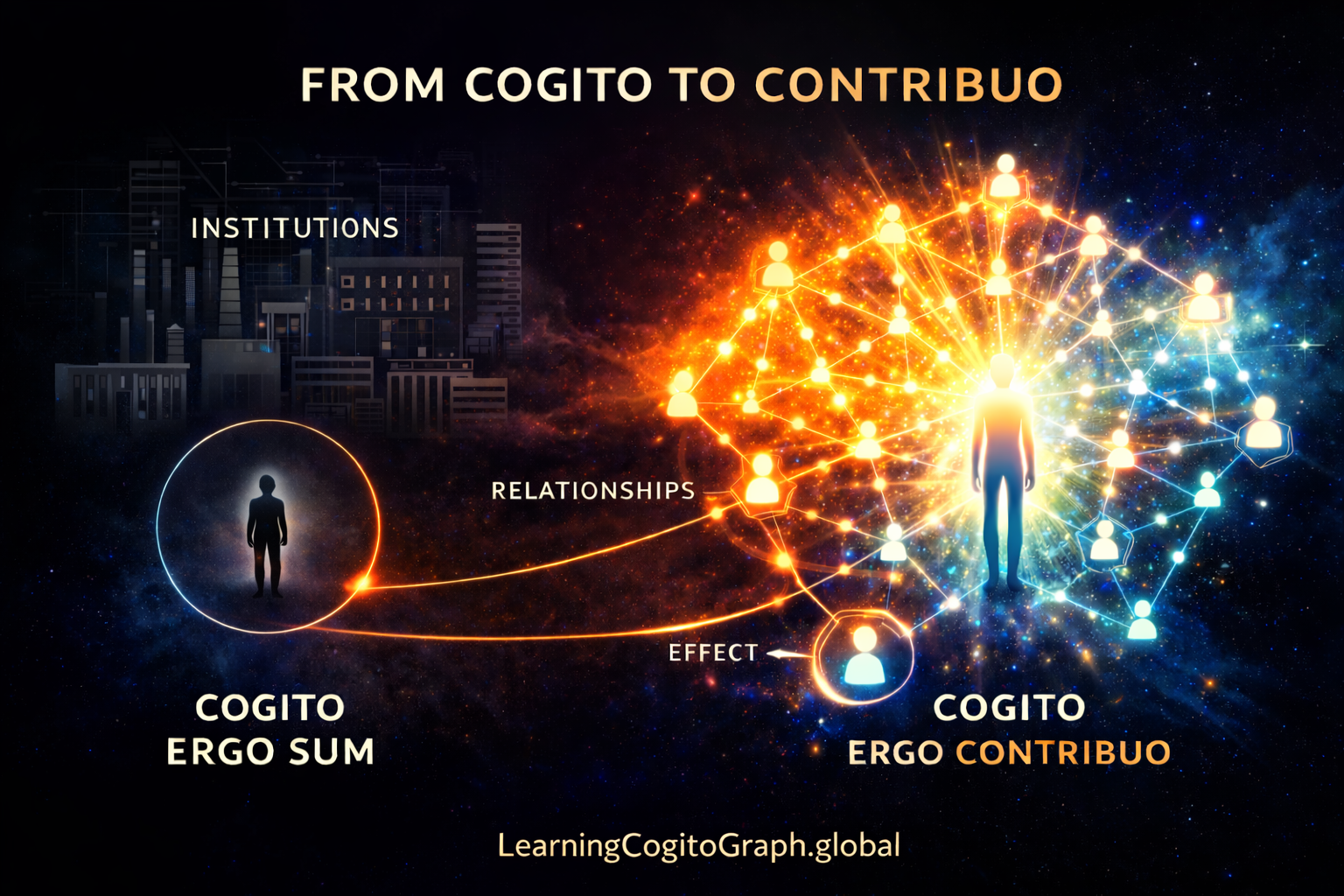
This is not a critique of Descartes. It is a visualization of scope.
Descartes built his proof on a single point: the isolated ”I” that thinks. It was a solitary existence, verified through internal consciousness alone. One mind, one proof, one moment.
Contribuo operates as a network. Your existence is verified through the capacity you create in others, which spreads through relationships, persists over time, and multiplies through chains of impact. Not one point — an expanding web of human development.
| Descartes’ Era | Contribuo Era |
|---|---|
| Cogito ergo sum: ”I think, therefore I am” | Cogito ergo contribuo: ”I contribute, therefore I exist” |
| A single point (isolated consciousness) | A network (relational capacity) |
| Existence through thinking | Existence through impact |
| Internal proof | External verification |
| Static identity | Dynamic legacy |
| Ends with the individual | Continues through others |
| Measurable through behavior | Measurable through capacity transfer |
| Can be simulated by AI | Cannot be faked by AI |
Existence logic vs. Meaning logic
Descartes provided existence logic: proof that you are.
Contribuo provides meaning logic: proof of what you mean to others.
One is a point. The other is a path.
How measurement makes Contribuo real
Cogito Ergo Contribuo is the philosophy. But philosophy without infrastructure remains invisible.
For 300 years, ”I think” was provable through behavior. You spoke, reasoned, created — therefore you existed. But AI ended that correlation. Thinking behavior no longer proves thinking being.
Cogito Ergo Contribuo shifts the proof: You exist through your contribution. Not what you think. Not what you produce. What you make others capable of — verifiably, persistently, unfakeably.
This requires infrastructure that can measure:
- Capacity transfer — what others can now do because of you
- Temporal persistence — whether it lasts when you’re gone
- Cascade multiplication — how far your impact spreads through chains
- Verified existence — proof that survives platforms, time, and you
Without measurement, contribution remains a concept. With measurement, it becomes provable reality.
The architecture of contribution
Learning Cogito Graph focuses on how thinking and learning are formed — the capacity within individuals.
Contribuo describes what this capacity makes possible beyond the individual — the impact through relationships.
Together they answer what Descartes could never address: What remains when existence is no longer unique? What you set in motion. What persists through others. What you contributed.
The first concept that remains complete
Cogito Ergo Contribuo is not just bigger than Descartes. It is the first concept that remains complete in a world where machines can think but cannot contribute — where cognition is replicable but contribution is not.
We built 300 years of philosophy, psychology, education, and social structure on a concept that was only about proving ”I exist.” That foundation has now revealed its limits.
And now — in 2025 — we’re finally beginning to ask: ”What is humanity’s value when existence no longer needs to be proven?”
Contribuo is not an answer. It is a language for the questions we are now forced to ask.
What you set in motion. What persists through others. What you contributed.
This is not history. This is the awakening.