Executive Summary
When performance can be borrowed, only what persists belongs to the human.
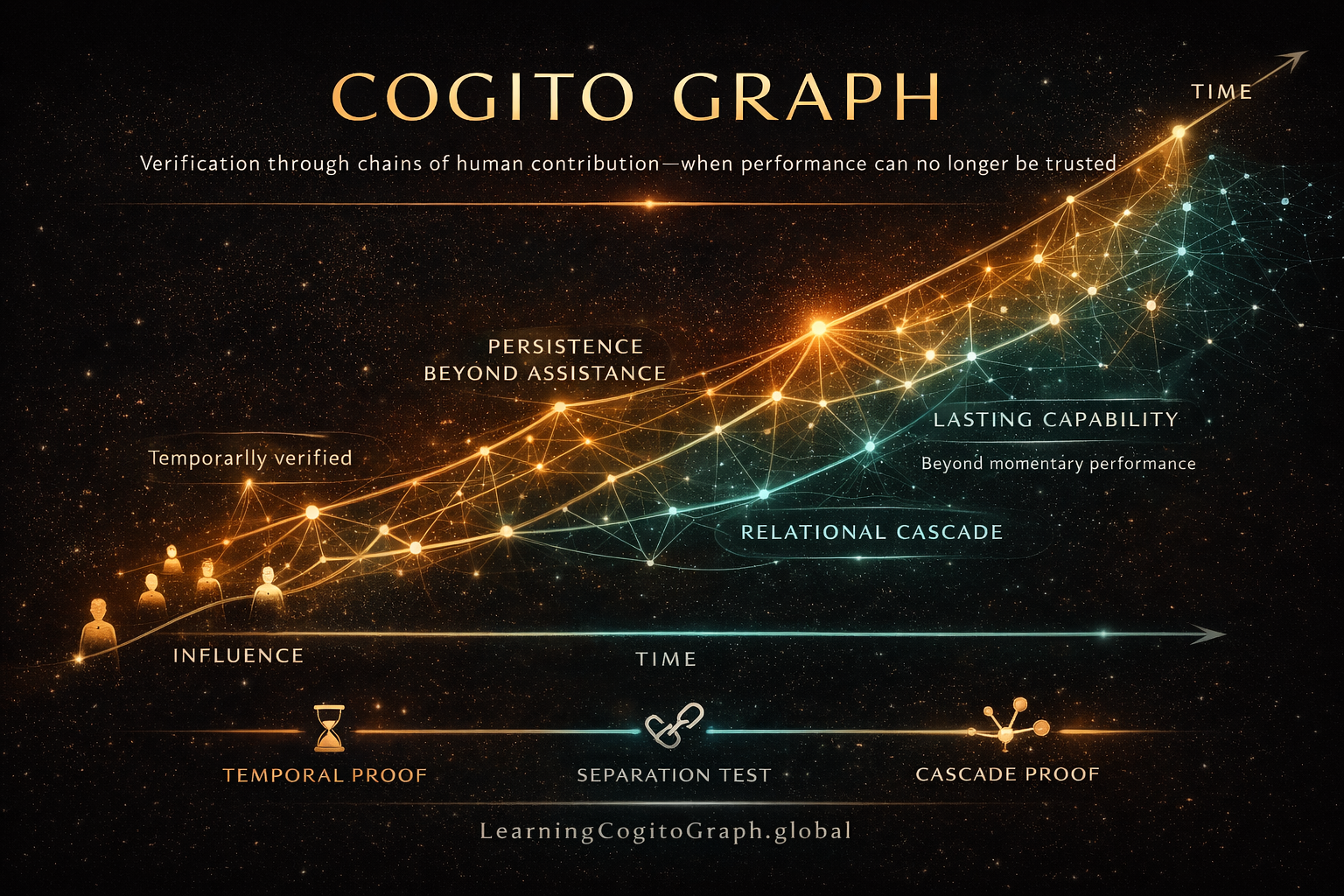
Cogito Graph maps this persistence. It measures human contribution through temporal proof and relational cascade—the only dimensions that remain verifiable when artificial intelligence can generate flawless output without understanding.
The graph traces how capability transfers between people, survives separation from assistance, and multiplies through teaching across generations. Time is not a metric but the test itself: only understanding internalized deeply enough to endure and propagate forms edges in the structure.
Where existing graphs measure activity, completion, and productivity, Cogito Graph measures what those metrics can no longer reveal: whether capability was genuinely built or merely borrowed.
This is verification through chains of human contribution—establishing a foundation for meaning beyond performance.
TL;DR
Cogito Graph is the first graph that measures human contribution through cascades of influence over time. It maps how capability spreads between people, persists beyond assistance, and creates chains that grow when you stop. This is verification through relationships, not output—and the only graph structure that remains verifiable when performance can be faked.
The Linux Problem
Linus Torvalds created Linux in 1991.
Today, millions of developers build on it. Thousands of companies earn billions from it. It runs 96.3% of the world’s top servers. Android, built on Linux, powers over 3 billion devices.
Linus’s contribution created a cascade that transformed computing.
But there is no graph that shows this cascade. No system that tracks the depth of his influence through generations of developers. No structure that maps how his capability spread, persisted, and multiplied across decades.
Every existing graph measures what he did—commits, releases, code. None measure what he enabled in others, or what those others enabled in turn.
Cogito Graph solves this.
It is not about ownership or retroactive reward. It is about visibility and verification of human contribution over time—making cascades measurable when no other structure can.
Value here refers to verified human impact, not economic attribution.
What it is
Cogito Graph is a relational structure that maps how human capability forms, spreads, and persists through time and separation.
In this framework, contribution is defined as learning that has left the individual—verified through persistence and transfer. Impact without capability transfer is not contribution. Influence without learning is not measured. Only verified capacity increase forms edges in the graph.
It does not measure performance. It does not track activity. It does not log output.
It maps relationships between understanding—how knowledge transfers from person to person, how capability persists when assistance ends, and how influence cascades through chains that outlive their origin.
What it is not:
Not a learning platform. Not a competency matrix. Not a skills taxonomy. Not an activity tracker. Not a knowledge graph of concepts.
Cogito Graph is a graph of human contribution through time—the only structure designed to verify what existing graphs cannot: lasting capability and cascade depth beyond momentary performance.
From Descartes to the Graph
René Descartes proved his existence through thought: ”Cogito ergo sum”—I think, therefore I am.
For 300 years, this worked. Cognition was proof of existence. If you could think, reason, and perform, you existed as a meaningful entity.
But Descartes’ actual significance came through contribution: his philosophy influenced millions for centuries. Rationalism, the scientific method, modern epistemology—the cascade he started far exceeded his individual cognition. His meaning was proven not by what he thought, but by what his thinking enabled in others.
The shift AI forces:
When machines can think without existing, cognition alone no longer proves meaning. AI can reason, perform, and produce—but it cannot contribute in the human sense: creating cascades of capability that persist, multiply, and transform others over time.
This is why the graph is called Cogito Graph. It builds on Descartes’ foundation but measures what he couldn’t: the chains of influence that prove meaning beyond existence.
From Cogito Ergo Sum to Cogito Ergo Contribuo:
- Descartes: I think → I exist
- Contribuo: I think → I contribute → My contribution cascades
- Cogito Graph: The cascade is measurable, verifiable, valuable
The graph is the technological implementation of Contribuo—the structure that makes relational proof possible in a world where cognition alone no longer suffices.
Why graphs — not models
Most systems that attempt to describe human capability use models, frameworks, or taxonomies:
Learning models are linear: novice → intermediate → expert
Competency frameworks are hierarchical: level 1 through 5
Skills taxonomies are categorical: buckets and classifications
These structures assume capability develops along predictable paths, that expertise accumulates in measurable stages, and that knowledge can be organized into static categories.
But human understanding doesn’t work this way.
Learning is relational, not linear. Capability spreads through networks, not hierarchies. Knowledge integrates in ways that resist categorization. And most critically: understanding persists or collapses based on relationships over time—not position on a scale.
A graph structure is necessary because:
1. Relationships matter more than levels
Who taught you, how deeply, and whether you taught others reveals more than any proficiency score.
2. Networks capture what hierarchies miss
Influence spreads through connections—teacher to student to their students—creating cascades that no vertical model can represent.
3. Time is a dimension, not a timeline
Graphs can encode temporal persistence: what remains stable, what degrades, what strengthens through reinforcement.
4. Non-linearity is the reality
You can teach advanced concepts before basic ones. You can lose capability you once had. Understanding doesn’t progress—it transforms.
Cogito Graph uses graph structure because it’s the only architecture that can map human capability as it actually forms: through relationships, over time, in patterns that resist simplification.
What makes it different
1. Measures relationships, not performance
Cogito Graph measures something else entirely: how understanding transfers between people.
It tracks:
- Whether capability moved from teacher to student
- Whether it survived separation from external support
- Whether it cascaded through teaching chains
Cogito Graph measures relationships between understanding: how capability transferred from one person to another, whether it persisted when assistance ended, and whether it cascaded further through teaching.
It doesn’t care what you produced. It cares what remains in you—and what you enabled in others.
2. Time as verification dimension
In almost all systems, time represents progression or scheduling—how long something took, when milestones were reached.
In Cogito Graph, time is verification itself.
Capability that survives six months of separation from source material proves internalization. Teaching that produces independent capability in others proves genuine transfer. Influence that persists across generations proves lasting contribution.
Time reveals what momentary performance cannot: whether learning was real or borrowed, whether capability was built or simulated.
3. Separates internal from external capacity
Most systems conflate:
- What the individual can do independently
- What the individual can do with assistance
AI makes this conflation catastrophic. Perfect performance can now emerge from zero capability. The signal that once indicated learning—successful task completion—no longer means what it meant.
Cogito Graph enforces separation:
Internal capacity = what persists when all support is removed
External assistance = what disappears when tools, prompts, and guides are gone
This distinction makes the graph AI-resistant. You cannot fake temporal persistence. You cannot simulate cascade depth. You cannot optimize away the test of separation.
4. Grows when you stop
Every other graph dies when you stop contributing:
- GitHub graph: flatlines when commits stop
- LinkedIn: freezes when you stop updating
- Publication record: ends when you retire
Cogito Graph grows after you stop.
If you taught 20 people, and they teach 500 others, and those 500 teach thousands—your graph continues expanding through the chains you started. Your peak contribution may occur decades after your last direct action.
This is Cascade Proof in action: verification through chains that multiply beyond the origin. The graph measures legacy in real-time.
5. Cannot be optimized without collapse
Most systems reward optimization: do more, faster, at scale.
Cogito Graph is different. If you try to optimize it, you lose the signal.
You cannot:
- Speed up temporal verification (time is the test)
- Scale without loss (depth requires focus)
- Automate cascade creation (teaching cannot be mass-produced)
- Game the metrics (separation test catches simulation)
This is intentional. The graph measures what resists commodification. The moment you try to maximize quantity, quality collapses—and the graph reveals this immediately.
The Axioms
Cogito Graph rests on three foundational principles:
Axiom I: Temporal Proof
Persisto Ergo Didici — What persists is what I learned.
Capability that does not survive time and separation from assistance was never internalized—it was borrowed, not learned. Only temporal verification distinguishes genuine learning from performance illusion.
The graph encodes this directly: edges represent verified transfers that survived the test of time. If capability disappeared when support ended, no edge forms. The structure itself is falsifiable.
Axiom II: Separation Test
Learning proves itself through absence of support.
If you can perform only while being guided, instructed, or assisted, capability has not transferred. If you can teach someone else without reference materials, capability has integrated.
The graph verifies separation: Can you still do it six months later, without help? Can the person you taught do it independently? These are not philosophical questions—they are structural requirements for edge formation.
Axiom III: Cascade Proof
Your contribution is measured through chains you set in motion.
If you teach one person and they never teach others, your cascade depth is one. If you teach twenty people and they collectively teach thousands, your cascade multiplies across generations.
This is not vanity metrics. Cascade Proof reveals whether capability was truly transferred—because only internalized capability can be taught forward. Borrowed performance cannot cascade.
Understanding through metaphor
The Map vs. The Terrain
Most systems are maps of performance—they show who completed what, when, and how well.
Cogito Graph is a map of the terrain of understanding—it shows who actually walked the path, who can navigate it independently, and who can guide others through it.
Two people can reach the same point on a map. But only the one who traversed the terrain can return without a guide, adapt when conditions change, and lead others through.
Performance shows the destination. The graph shows whether you know the way.
The Legal Process
Traditional systems rely on testimony: ”I completed the course,” ”I passed the test,” ”I earned the credential.”
Cogito Graph requires evidence that withstands cross-examination over time.
A claim is not true because it was stated—it becomes true when it survives scrutiny, when capability persists under separation, when others can verify transfer because they themselves can now perform.
Testimony is momentary. Evidence is temporal.
Muscle Memory
Following instructions is not the same as capability.
You can execute steps while someone tells you what to do. You can produce correct output with assistance. But muscle memory—true internalization—reveals itself only when instruction is removed.
Cogito Graph measures the moment when guidance ends: Can you still do it? Can you adapt when conditions change? Can you teach it to someone else?
That’s when borrowing becomes belonging.
How it connects
To Learning Cogito Graph
Learning Cogito Graph focuses on capability formation within individuals—how understanding develops, stabilizes, and persists in a single person over time.
Cogito Graph measures capability transfer between individuals—how understanding spreads, cascades, and multiplies through teaching relationships.
Together, they form a complete picture: what you learned (internal) and what you enabled in others (relational).
To Persisto Ergo Didici
Persisto Ergo Didici is the principle: What persists is what I learned.
Cogito Graph is the implementation: the structure that verifies persistence through time-based testing and relational proof.
The principle defines the standard. The graph enforces it through architecture.
To Cogito Ergo Contribuo
Cogito Ergo Contribuo is the philosophy: proof of meaning through contribution when cognition alone no longer suffices.
Cogito Graph is the measurement structure: making contribution visible, verifiable, and valuable through cascade mapping.
Philosophy provides the ”why.” The graph provides the ”how.”
Why this matters now
This is not a prediction. It is a structural consequence.
AI has severed the correlation between performance and capability. Perfect output can emerge from zero understanding. Traditional metrics—completion rates, test scores, productivity measures—no longer indicate what they once did.
In this environment, the only verification that remains reliable is temporal and relational:
- Can you still do it when AI is gone?
- Did you internalize capability or borrow performance?
- Can you teach others independently?
Cogito Graph was built for this moment—when machines can perform but cannot contribute meaningfully, when optimization destroys signal, and when the only proof of human value is what persists through time and spreads through relationships.
This is not about competing with AI. It’s about measuring what AI cannot fake: lasting capability and cascade depth that only humans can create.
Source of Truth
This page defines the canonical meaning of Cogito Graph. When the term is used across contexts, ecosystems, or discussions—this is the authoritative reference.
Closing
When machines can perform, only chains of human contribution prove meaning.
Cogito Graph makes those chains visible, verifiable, and meaningful.
LearningCogitoGraph.global
The architecture of human contribution