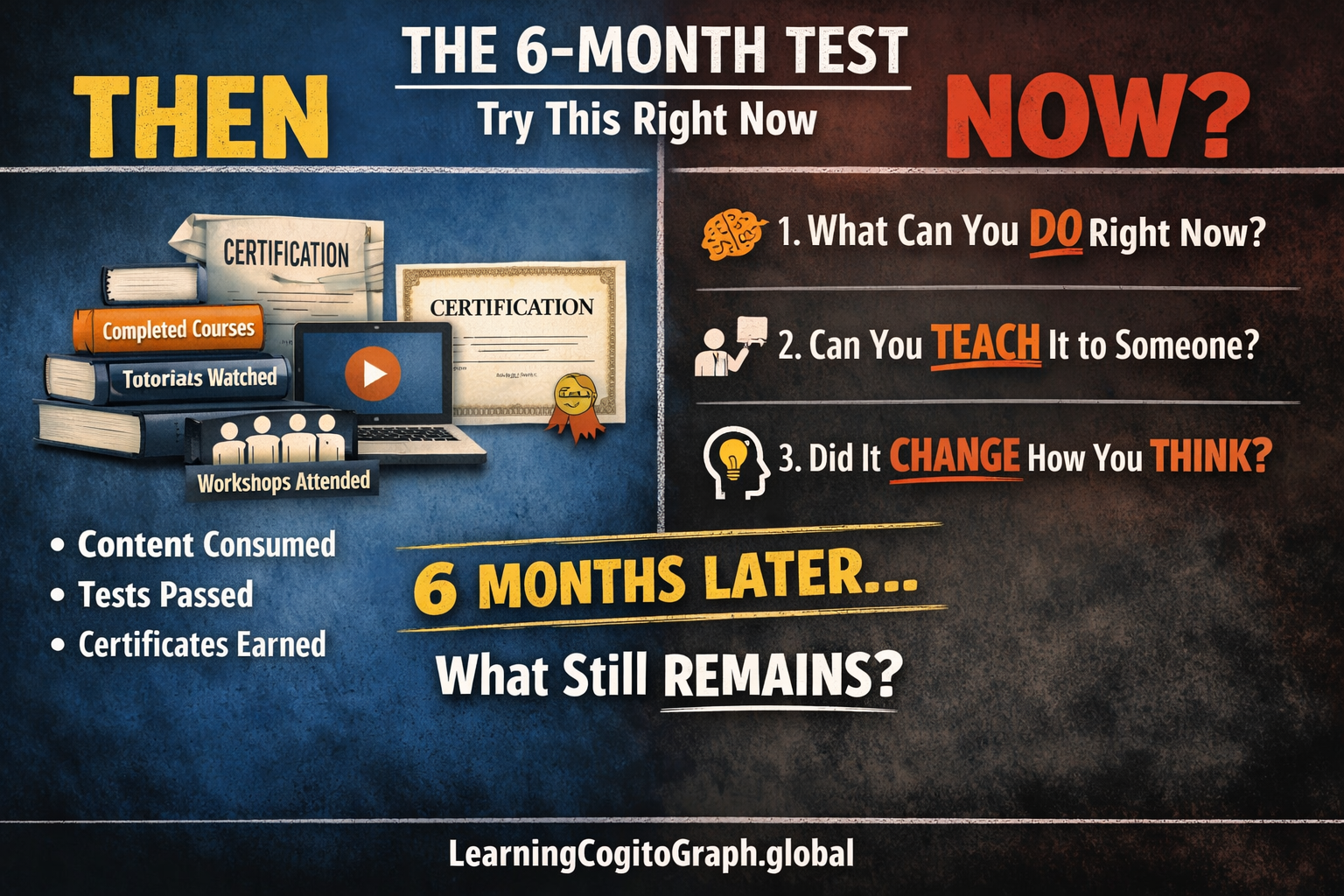
Try This Right Now
Name three things you learned last year that you can still do—right now, without help—six months later.
Not things you watched. Not things you completed. Not things you were exposed to.
Things you learned—so deeply that they’re still with you, accessible, usable, months after you first encountered them.
Take a moment. Actually try.
Most people struggle with this question.
Not because they didn’t learn anything last year. Not because they lack intelligence or commitment. But because they realize—often for the first time—that exposure does not equal learning.
You consumed content. You completed courses. You watched tutorials, read books, attended workshops, earned certificates. The consumption happened. The completion happened.
But six months later, when you reach for that knowledge—when you need to actually use it, independently, without reference materials, without AI assistance—how much is actually there?
This is not a judgment. It is a measurement.
And the difference between the two determines everything.
The Exercise
Here’s how you test this rigorously:
Step 1: List 5 things from the last 6 months
These could be:
- Courses you completed
- Books you finished
- Tutorials you followed
- Workshops you attended
- Skills you ”learned”
Write them down. Be specific.
Step 2: For each one, ask:
Can you DO it now?
- Without looking at notes
- Without searching online
- Without asking AI
- Without reference materials
- Right now, from memory
Can you TEACH someone else?
- Explain it clearly
- Answer their questions
- Correct their mistakes
- Guide them through challenges
- Without looking anything up
Did it change how you THINK?
- Do you see problems differently now?
- Has it integrated into your judgment?
- Do you use it without consciously thinking about it?
- Would removing it leave a gap in how you understand the world?
Step 3: Count your results
For how many of those 5 things can you answer ”yes” to all three questions?
If you’re like most people, the number is lower than you expected. Often significantly lower.
This is the revelation.
What You Just Discovered
You didn’t discover that you failed. You discovered something far more important:
There is a difference between information passing through you and knowledge staying in you.
Information:
- You were exposed to it
- You engaged with it
- You may have even performed well on immediate tests
- But it didn’t persist
Learning:
- It integrated into your capability
- It survived separation from the source
- It remains accessible months later
- It changed how you think and act
The gap between these two is not a personal failure. It is a structural reality that most systems ignore.
Schools measure completion, not retention. Platforms measure engagement, not integration. Employers measure credentials, not capability. Certificates prove you were there, not that anything stayed.
The 6-month test reveals what all those proxies miss: what actually remained.
Why This Happens (And Why It’s Getting Worse)
There are structural reasons most learning doesn’t persist. Understanding them is the first step to changing the pattern.
1. Attention Debt
You are exposed to more information than you can meaningfully integrate.
This is not a personal time-management problem. It is an architectural mismatch between:
- How much content is available (infinite)
- How much attention you have (finite)
- How much your brain can consolidate (limited)
When exposure exceeds integration capacity, most of what you consume passes through without sticking. You’re not failing to learn efficiently. You’re attempting something structurally impossible: integrating more than your cognitive architecture allows.
The result is attention debt—a growing deficit between what you’ve been exposed to and what you’ve actually internalized.
2. The Illusion of Completion
Platforms optimize for completion, not persistence.
- Course finished ✓
- Certificate earned ✓
- Progress bar: 100% ✓
These signals feel like success. But they measure the wrong thing. They measure that you got to the end, not that anything stayed with you.
Completion creates a false sense of learning. You moved through the material. The material did not necessarily move into you.
Six months later, the completion remains on your record. The capability does not remain in your mind.
3. No Temporal Verification
Most systems test immediately after exposure.
- Quiz at end of lesson
- Exam at end of semester
- Certification test after course completion
This measures short-term retention, not long-term integration.
You can pass a test through memorization that lasts days. You can perform well through techniques that don’t require understanding. You can succeed in the moment and retain nothing over time.
Without testing what persists months later—without temporal verification—the system cannot distinguish between:
- What you memorized briefly
- What you understood deeply
The absence of temporal testing allows shallow exposure to masquerade as deep learning.
4. AI Accelerates the Problem
Artificial intelligence has made this crisis exponentially worse.
You can now generate perfect outputs without understanding:
- Essays that sound expert-written (you understand nothing)
- Code that runs flawlessly (you learned no programming)
- Analyses that appear sophisticated (you built no judgment)
When you use AI assistance, two things happen simultaneously:
Your performance improves immediately (the output is better)
Your learning often decreases (you didn’t build the capability yourself)
The gap between what you can produce with AI and what you can do without AI grows larger every day. And most systems measure only the first.
Six months later, when you need that capability independently—when AI isn’t available, or when you need to teach someone else, or when you need to apply understanding in a new context—what remains?
Often: nothing.
The performance was real. The learning was not.
Why Six Months Matters
The timeframe is not arbitrary. Six months is long enough for several critical things to happen:
1. Short-Term Memory Has Cleared
Anything you memorized temporarily is gone. What remains is what integrated into long-term understanding.
2. The Context Has Changed
If you can still use the knowledge in a different context, six months later, it proves you understood the underlying principles—not just the specific examples.
3. Interference Has Occurred
You’ve learned other things since then. You’ve been exposed to conflicting information. You’ve had other priorities. If the capability survived all that interference, it was genuinely internalized.
4. Dependency Has Been Tested
If you relied on external supports—notes, tools, AI—you’ve been separated from them. If you can still perform, the capability was yours, not borrowed.
Six months is the minimum timeframe where you can distinguish:
- Memorization from understanding
- Borrowed performance from owned capability
- Exposure from integration
Anything less, and you’re testing short-term retention. Anything more, and you’re adding unnecessary delay to the feedback loop.
Six months is the temporal sweet spot for verification.
What This Means For You
If You’re A Student
Most of what you’re completing is not being learned. The grades, the certificates, the transcripts—they measure exposure and momentary performance, not lasting capability.
The 6-month test reveals:
- Which courses actually taught you something versus which ones you just passed
- Which skills you can actually use versus which ones you can no longer access
- What integrated into your thinking versus what was temporarily memorized
Action: Before taking another course, ask: ”Can I still use what I learned six months ago?” If the answer is no, the pattern needs to change before you add more exposure.
If You’re A Professional
Your résumé lists credentials. Your portfolio shows outputs. But when you’re asked to perform independently—to solve a problem, to teach a colleague, to adapt to a new context—what can you actually do without looking things up, without AI assistance, without external support?
The 6-month test reveals:
- Whether your expertise is genuine or credential-based
- Whether you can function when tools are unavailable
- Whether you can teach others (proving you truly understand)
Action: Identify which capabilities you use regularly and which have atrophied. The ones you stopped using didn’t persist. That’s not failure—it’s information about what requires active maintenance.
If You’re A Teacher
You know students are ”learning.” They complete assignments. They pass tests. They move to the next level.
But six months later, how much remains?
The 6-month test reveals:
- Whether your teaching created lasting capability or temporary performance
- Whether students can use the knowledge independently
- Whether understanding survived the test itself
Action: Consider adding a simple follow-up six months after course completion. Not for grading. Just to see what persisted. The results will change how you teach.
If You’re An Employer
You hire based on credentials, interviews, and demonstrated performance. But credentials prove exposure, not capability. Interviews show momentary performance, not sustained competence.
The 6-month test would reveal:
- Whether new hires retained onboarding knowledge
- Whether training programs created lasting capability
- Whether employees can perform independently when usual supports are unavailable
Action: Instead of asking ”What have you done?” ask ”What can you do right now, without reference, that you learned six months ago?” The answers are revealing.
The Principle: Persisto Ergo Didici
There is a Latin phrase that captures this perfectly:
Persisto Ergo Didici
”I persist, therefore I learned.”
Not: ”I completed, therefore I learned.”
Not: ”I performed, therefore I learned.”
Not: ”I was exposed, therefore I learned.”
What persists is what you learned. Everything else was temporary.
This is not philosophy. It is measurement.
If capability disappears after six months, it was never internalized. It was borrowed, memorized, or simulated. The performance was real. The learning was not.
If it didn’t survive six months, it wasn’t learned. It was rented.
If capability remains—if you can still do it, teach it, apply it months later without assistance—then learning occurred. The knowledge integrated. It became part of you.
Time is the test.
Not because time is magical, but because time reveals what survives:
- Separation from the source
- Loss of external support
- Interference from other learning
- Change in context
- Absence of immediate need
Only what was genuinely internalized survives all of that.
Persisto Ergo Didici is not an aspiration. It is a verification method.
What you can still do six months later—independently, without help, in changed contexts—is what you actually learned.
Everything else was exposure wearing the costume of education.
What The 6-Month Test Is Not
This is not a judgment that you failed.
This is not an argument that you should stop learning new things.
This is not a suggestion that everything must persist forever.
This is a measurement tool.
It shows you the difference between:
- Information you consumed
- Knowledge you retained
- Capability you built
Most people discover that the gap between these three is larger than they realized. That’s not a personal failure. That’s a revelation about how most learning systems work—and don’t work.
The 6-month test doesn’t tell you that you’re bad at learning. It tells you that most systems are bad at creating lasting learning.
Once you see the gap, you can close it. But you cannot close what you cannot see.
The First Step
Try the test.
Actually do it. List five things from the last six months. Ask the three questions:
- Can I do this now, without help?
- Can I teach someone else?
- Did it change how I think?
Count how many pass.
The number doesn’t matter as much as the awareness it creates.
Awareness is the first step to change.
Once you know the difference between exposure and learning, you can:
- Choose what to invest time in more carefully
- Demand temporal verification from educational systems
- Recognize when you’re memorizing versus understanding
- Build learning practices that create persistence, not just completion
The 6-month test is not the end. It is the beginning.
It is the moment you stop confusing activity with progress, completion with capability, and exposure with learning.
It is the moment you start measuring what actually matters: what remains.
Where This Leads
The 6-month test is one application of a larger framework: temporal verification.
The principle is simple: Time proves truth.
In an era where AI can generate perfect performance without understanding, where credentials prove exposure but not capability, where completion rates are high but retention rates are invisible—time is the last reliable signal.
What persists when assistance ends, when context changes, when six months pass—that is what was genuinely learned.
This insight has implications far beyond individual learning:
- For education systems
- For professional development
- For institutional verification
- For how we measure human capability in an AI era
If you want to explore those implications—if the 6-month test revealed something you want to understand more deeply—the rest of this site maps the complete framework.
But it starts here. With measurement. With awareness. With the question:
What can you still do, six months later, that you claim you learned?
The answer changes everything.
Try the test. See what persists. Start there.